

I’ve learned that people will forget what you said, people will forget what you did, but people will never forget how you made them feel.– Maya Angelou
As I’m writing this message (yes, I know, I bit later than the usual promised Sunday), I hear and see many people around me that are complaining about the lack of quality time with dear ones. The rhythm of this summer has been quite hectic. Trapped among to do’s and planning for the latter part of 2025, I think we can all agree we turned summers more and more into active times in between what we didn’t close in spring and the prospects we need to arrange for the end of the year.
Way too often, we turn busy into being and it is taking a toll in the long run.
For our bodies, minds but most of all, for our souls. We are evolving into individualistic beings, interested in self-development and we forget that we can only be as good, evolved, healthy as the people around us. Like the old saying says: If you want to go fast, go alone. If you want to go far, go together.
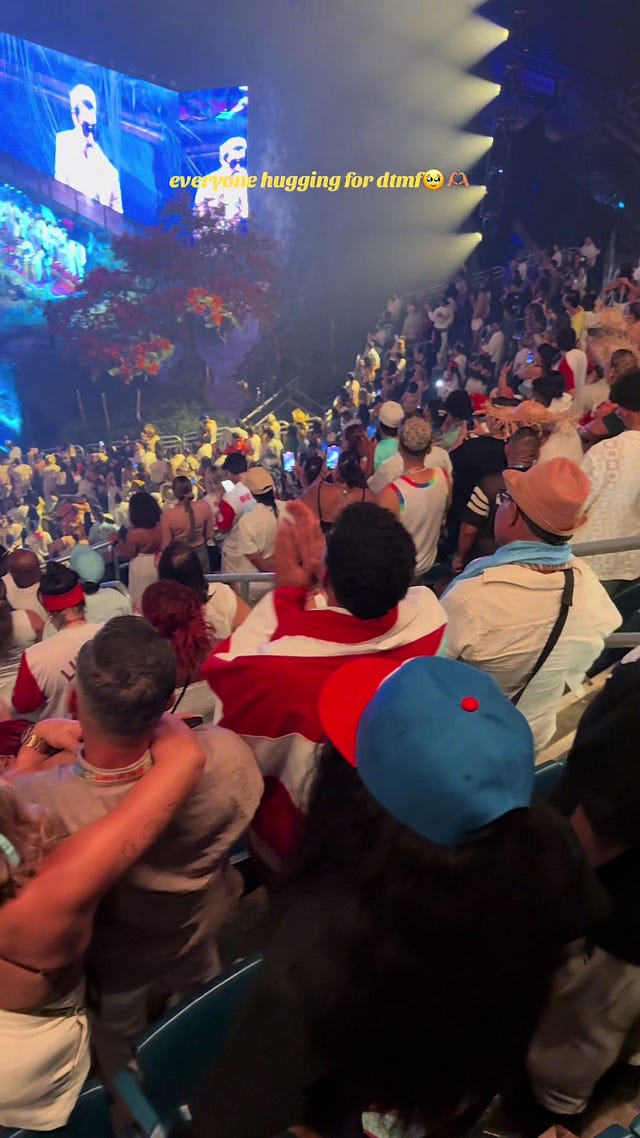
The other day, I came across an emotional video from one of Bad Bunny’s Puerto Rico residence concerts. The energy of the masses is yes, contagious. But another thing caught my eye. They were all holding each other. Into rows of pure human energy. They didn’t need to sing, they were already attuned to the artist, the words, the melodies, the vibe. Somehow, before singing the words, connectivity started in holding each-other and transmitting waves of joy all around. There was something almost heavenly about seeing our species entangled in one of the most natural and nurturing way of communication: togetherness.
Archaeologists tell us that early humans carried heavy stones and hunted game not just for themselves, but for the group, evidence that generosity was as essential to survival as strength. Over time, these circles grew into villages, into cities, into cultures.

Nature mirrors our own understanding of safety and progress. In forests, trees are linked underground by a vast fungal network, passing nutrients and signals to each other, the “wood-wide web.” In the savannah, elephants travel in herds that shelter their young in the middle. In the ocean, orcas move in pods that hunt and protect together.
Everywhere in nature, life is cooperation and togetherness.
Our biology will never forget what the mind sometimes does: we are made to experience life together.
When we hug, hold hands, or sit shoulder-to-shoulder, our bodies release oxytocin, the hormone that builds trust. Cortisol, the stress hormone, drops. Heart rate slows. Blood pressure steadies. By contrast, studies now show loneliness and separation can harm health as much as smoking fifteen cigarettes a day.
In all eras, connection kept and will keep us alive and well.
We can feel it in real time: the way a friend’s hand on our back softens the knot in our chest. The way shared laughter loosens something heavy inside us. Our nervous systems talk to each other beneath the level of words. We can send a thousand messages, but nothing replaces the alchemy of being in the same room. Of looking into each other’s eyes.
Presence carries what technology can’t: the micro-shifts in expression, the sync of breath, the grounding warmth of skin near skin.
During the pandemic, many of us learned the hard way that even daily video calls couldn’t satisfy the hunger for being together. Face-to-face contact offers something irreplaceable: a full-spectrum exchange of signals that tell the body, you are safe, you belong.
We are swiftly stepping into a world where artificial intelligence will be everywhere, solving problems, writing code, even simulating love conversation. But no matter how advanced it becomes, it will never offer the warmth of a human embrace or the electricity of presence.
Mo Gawdat, a former Google executive, calls human connection the most valuable currency of the future. In times when machines will handle more of our tasks, our ability to comfort, to read a room, to hold space for someone’s grief or joy, those will be the skills that matter most.
AI will learn to create the perfect idea. But it will not be able to confort you and make you feel less alone the same as real connection would.
The story of our species has always been a story of us. We began around the fire. We built cities and networks. Now we stand at the threshold of a new era, with tools our ancestors couldn’t imagine. How we will direct these shifts…it really is a choice.
Connection can be found in the simplest of gestures. Drinking coffee in the morning really intentionally beside your family and off your phone. In sharing activities with your loved ones. In deciding to work collaboratively and meet with your work colleagues. In loving IRL more than you are swiping on an app.
We are wired for each other. We are built for tribes and communes.
Across the long arc of human history, we have survived not because we were the fastest or the strongest, but because we belonged to each other. Long before skyscrapers, contracts, and career ladders, our ancestors lived in clusters of huts or under the open sky, moving as one body and energy. They shared food, raised children together, mourned and celebrated as a unit. The tribe, whatever shape it took, was the original life-support system.

You can still see this truth alive today in places where communal life is still a daily reality. In parts of Indonesia, for example, multiple generations share one compound. Kitchens are open to the whole family. Children grow up with aunts and uncles as second parents, grandparents as constant guides. These micro-moments of togetherness are part of the nervous system of the group, continuously regulating and reassuring its members.
Across the Pacific, in parts of South America, the market square still functions as both an economic and emotional hub. Psychologists studying these cultures note that frequent, low-level social contact doesn’t just feel good, it keeps cooperation smooth, reduces conflict, and strengthens the group’s resilience in hard times.
The pattern is universal in more matrilineal or community-oriented societies: life is organised not around the lone individual, but around the interwoven “we.” Work happens in teams where roles shift fluidly, each person stepping in where they’re needed. Decisions are made in circles, not behind closed doors. Children are the shared responsibility of the community. The health of one is the health of all.
Compare this to the hyper-individualist model dominant in much of the modern world. Here, independence is prized above interdependence. Personal space is defended at the cost of shared space. Nuclear families live in isolation, far from extended kin. We are encouraged to “stand on our own two feet”, a phrase that sounds strong until you remember that, in evolutionary terms, standing alone was a death sentence. Anthropologists have shown that early humans cut off from their group rarely survived. Our nervous systems are still wired for tribe, but our social structures often leave us to fend for ourselves.
The cost is measurable. Without the daily micro-support of a tribe our stress systems run hotter, our immune systems weaken, and our emotional resilience erodes. We become more anxious, more suspicious, more fragile.
The irony is that even in our fragmented cities, tribes still form. They are there in your workplace team that pulls together under a deadline, in the circle of friends who show up when you’re sick, in the family WhatsApp group that buzzes every morning. A tribe is any group that shares responsibility for one another’s survival, physical, emotional, or spiritual. It might be blood relatives, colleagues, neighbours, or fellow volunteers. What matters is the steady exchange of support, trust, and presence.
We thrive in these micro-tribes because they mirror the way we evolved to live: embedded, connected, responsible for and to each other.

If I can give a headline to the next two decades, it’s this: we survive and prosper together. Pluto’s long passage through Aquarius (settling in and holding court to the mid-2040s) presses on systems, networks, and the social fabric itself, forcing deep reform where our communities either fray or fortify. Aquarius is the circuitry of the collective; Pluto is the voltage of transformation. Put them together and the message is clear: power shifts to the networked, those who pool resources, build mutual aid, share intelligence, and design fair rules of participation.
On the personal plane, Pluto transits are uncompromising teachers: they purge what’s performative, leaving what’s essential and resilient. In Aquarius, they ask us to become better collaborators, emotionally fluent, technically literate, civically engaged. The wealth that compounds here is social capital: the reputations built on reliability; the alliances forged through shared work; the safety nets woven by showing up again and again. Health follows the same law: nervous systems co-regulate in loving community; chronic stress eases when care is distributed; prevention thrives when knowledge is shared. If Capricorn’s era optimised empires and verticals, Aquarius optimises networks, and networks thrive on reciprocity. (source: The Astrology Podcast)
So what does “strategy” look like under Pluto in Aquarius? Form your tribes, communes, group, sisterhoods, at work, at home, in your block, online, but make them real, consistent, reciprocal, embodied when possible.
Every species that survives does so together. The forest. The herd. The pack. The pod. Us. So don’t wait for the big moments. Call someone now. Walk with them. Share a meal. Hug longer than you think you should. Stand close enough to feel a heartbeat that isn’t your own.
Because the truth is simple: we live better, longer, and truer when we live together.
“Humans are fundamentally a social species,” as psychologist Julianne Holt-Lunstad puts it, and the need to be social is part of our neurobiology. Crucially, it’s not just about having people around you, but having meaningful connection with them.
The story of humanity is a story of connection. And as we write the next chapters with AI by our side, it’s comforting to know the plot remains the same: we need each other.